
A daring team of deerstalkers is restoring native woodland to the Scottish Highlands by breaking from traditional gamekeeping practice…
I write from Creag Meagaidh (Creg MEGee), a beautiful nature reserve of Munros, monolithic crags and sprawling upland plateau sited on the north shores of Loch Laggan, due west of the Cairngorms national park in the Scottish Highlands. I ventured into Creag Meagaidh as a residential volunteer for the summer of 2023, having heard about the resurgent bloom of life which has emerged under the stewardship of NatureScot, Scotland’s Nature Agency. Since NatureScot purchased the Creag Meagaidh highland estate in the mid-1980s, they have taken radical action to revive the landscape. My experiences living on this reserve and further study into the political landscape of rural life in Scotland have revealed a diamond in the rough; a shining story of hope for both the nature and people that call the Highlands home.
When NatureScot purchased Creag Meagaidh in the 1980s, they acquired 4000 hectares of land which spanned from the tops of alpine mountains down to a lowland loch-shore. This land had previously been under the management of the Adverikie sporting estate, whose management of the land over a number of decades had intensified an inconspicuous but insidious form of interference with nature. What was this land-use? Surprisingly, it wasn’t conversion to any of the extractive or intrusive industries held in contempt by environmentalists – namely, open-cast mining, plantation forestry, animal agriculture or even golf courses; it was in fact, to a large degree, simply how populations of a native wild animal were managed by the estate.
This is the point at which some history needs to be told. Since the late-18th century, red deer have been managed by sporting estates across vast swathes of the Scottish Highlands so that estate owners and their clients can indulge their thirst for the hunt. Wealthy customers pay eye-watering fees to stalk and shoot a beast, so the cost incurred presupposes success, so the incentive for gamekeepers has been to maintain deer population densities at an artificially high level to allay the risk that their customers go home empty-handed. Unfortunately for nature, where deer exist at high stocking densities, they will browse and munch almost all vascular plants to within an inch of their lives. In doing so, they reset the clock of ecological succession, arresting plant life, and much other wildlife besides, in a depauperate state. What you and I believe to be the harmonious, wild Scottish Highlands, is really just an impoverished assemblage of species inhabiting a barren habitat of stunted heather and grasses, constantly held in check by an inflated deer population.
Rory, the current reserve manager and deerstalker-in-chief used to work the land when it was under the management of the Adverikie estate. At the time of land conveyance he was convinced, like most other gamekeepers are today, that the only way to provide economic opportunities and sustain communities in remote areas of Scotland, was to unscrupulously defend the sporting-estate regime. He went from actively lobbying against nature conservation, to becoming the lifeblood of a leading Scottish nature reserve, where he champions the protection of nature and condemns the persecution of wildlife on traditional estates.
Rory’s change hasn’t come without consequences; he has had to deal with estrangement from the traditional game-keeping community. But he remains steadfast. He tells me that his dream is to regenerate the land to “a piece of Scotland it would have been 600 years ago”, when deer were in a significantly healthier balance with the environment thanks to native populations of grey wolves. To this end, since the mid-1980s, his and NatureScot’s bold plan has been to mimick the behaviour of this now extinct predator.
Enacting the wolf’s savage occupation Rory and his fellow deer-stalkers began to cull deer at a strikingly high and sustained rate through incessant expeditions into the reserve, with the mission of bringing population densities down in line with quotas set by the Deer Commission for Scotland.
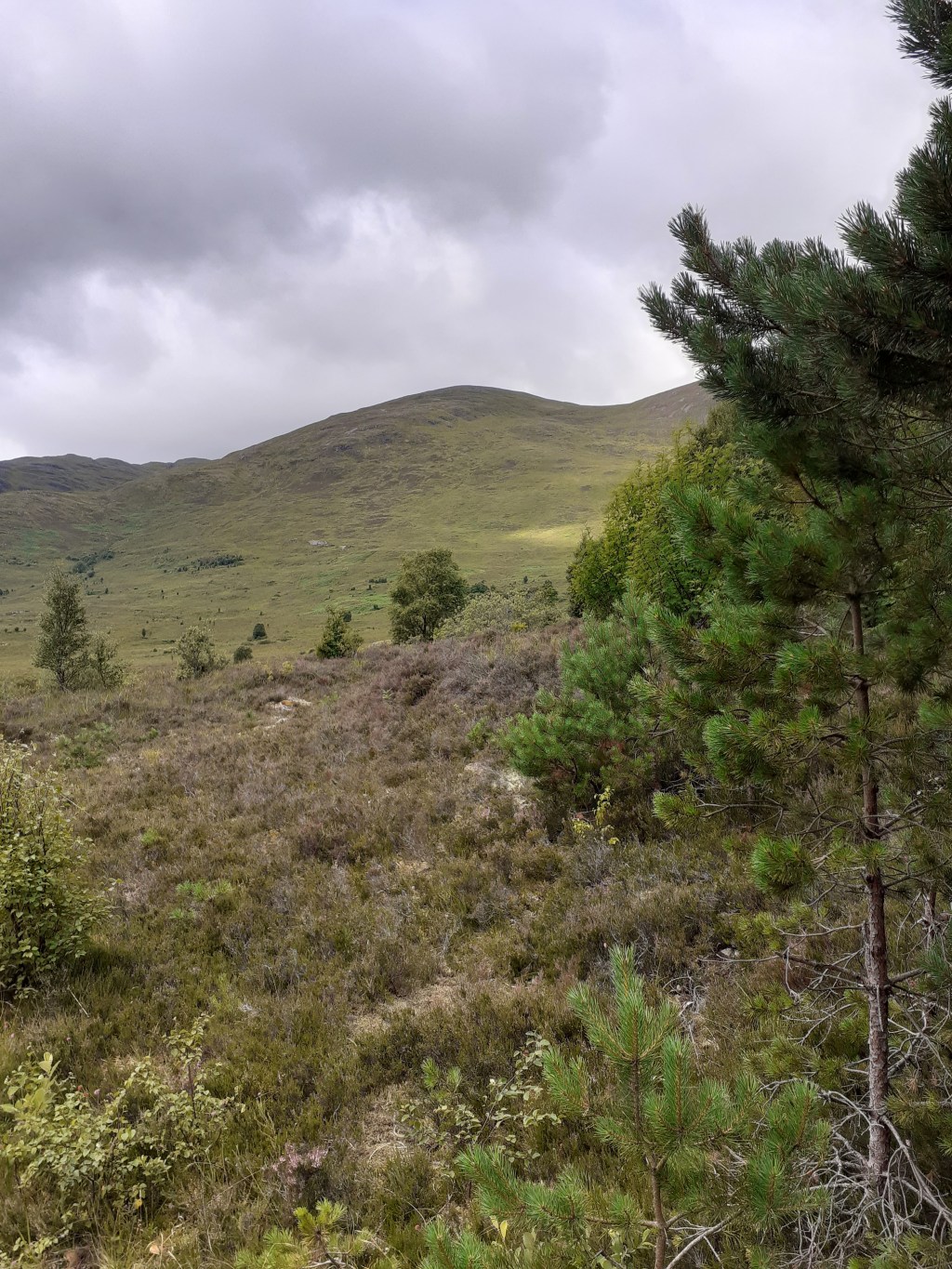
40 years on from the establishment of the reserve, as I beat the path up the main trail, holding historical photographs of the reserve and looking upon the hills, it is obvious that the team’s contrivance has been working. Vibrant seedlings and saplings of downy birch, rowan, aspen, bird cherry and eared willow have burst out of the sea of heather and bracken and are slowly climbing their way up the slopes and into the corrie from nearby seedstock.
The system has been shunted into a new equilibrium; a power-sharing arrangement between deer and plant. The flourishing of young trees and shrubs has lead to a biological trickle-down effect. The glut of niches and habitats conferred by the messy forest-heath mosaic has begun to support a thriving economy of birds, beasts and bugs. Bilberry and cowberry, now growing to their full potential, offer an abundance of fruit for insects, grouse and fieldfares. The grouse and smaller birds now find homes in expanding birch thicket. Golden eagles, peregrines and hen harriers searching for their newfound quarry amongst the tangled groves carve majestic swooning paths through the sky above the hill. Fly agaric, a fungus symbiotic with birch trees, now rises out of the leaf mould in dark corners of woods, adding to the medley of fungi on the reserve. Scottish wildcats – forest animals – re-introduced a stone’s throw away in the Cairngorms, linger on the fringes, the stage set for their return. Creag Meagaidh is a land in flux where formerly suppressed natural forces are slowly being unleashed. The benefits here are hard-fought; and it will take many more decades of work for the full natural capital potential be realised.
This sounds all good, but as mentioned, Creag Meagaidh sits in the midst of a populous who venerate gamekeeping for its job and wealth creation and for keeping rural communities alive. Worries stemming from histories of rural depopulation or changes to rural values from disruption to the land-economy are deeply etched into the consciousness of Highlanders. So, have these fears come to pass as a result of the Creag Meagaidh experiment? It appears not.
Firstly, the reserve staff use exactly the same corpus of deer management skills as on sporting estates, and in fact many of the contractors who come to work on Creag Meagaidh also work on sporting estates. It seems that, unlike other areas of the green revolution, be it transitioning oil rig engineers to offshore wind turbines or training an army of solar installation experts, the biodiversity revolution already has a latent workforce with the requisite skills in place.
In terms of economics, private estates are hard to pip. Extortionately wealthy landowners, many of them foreign investors, inject significant capital into their estates, tolerating net losses in the pursuit of conspicuous displays of status, and providing well-paid jobs for rural workers. However the new approach at Creag Meagaidh has shown that public ownership unlocks other kinds of income that communities didn’t even realise were possible before. The reserve has created new revenue streams which make the enterprise more cost-effective. Sustainable wild venison, in abundance from the high cull rate, is sold to visitors and a new micro-hydropower scheme not only powers the reserves facilities and vehicles, but brings in tens of thousands a year more by selling to the grid. In terms of financial sustainability, nature conservation hasn’t ever been so lucrative.
This independence from estate-owner interests has allowed many social benefits to materialise that simply do not occur on private lands. Visitors from diverse backgrounds are welcomed with free parking, free camping facilities and mixed-ability and wheelchair accessible footpaths; rural skills training is run for local school children to prepare them for future countryside employment; residential placements are offered for people to gain experience in practical conservation; and local contractors swoon in to assist in all kinds of estate maintenance activities. An innovative community stalking group has opened up where all deer-stalkers can assist with the hunt or can be trained to do so, breaking from the traditional model that keeps stalking opportunities between gamekeepers and their friends. More opportunities yet unknown will be realised as the land transitions.
Community opinions of the project are good too. A recent survey showed that many locals, whilst initially resistant to NatureScot’s proposals, are now supportive of the project. Several universities undertake or show interest in pursuing research to measure and understand the changes to the ecosystem. The only vocal opposition now comes from gamekeepers who feel their livelihoods are under threat. Yet, if Creag Meagaidh has demonstrated anything, it is that even more gamekeepers doing even more deer killing are needed for nature conservation in the Highlands.
Similar projects to Creag Meagaidh, such as Bamff and Dundreggan are gaining some traction around the Highlands. Whilst they vary on approaches to deer management and tree regeneration, they all recognise a common issue, biodiversity loss; recognise the main driver, land-use regimes; and share a common goal to deal with it, improve ecosystem structure and function. Creag Meagaidh stands out for it’s story. The hard-won change in the landscape really reflects the modesty and openness to change in one man’s heart, and the intelligence, empathy and ingenuity to carry it out for benefit of nature and the wider community. As this story of change exemplifies, creating a revived Scottish natural landscape appears not to be impeded by technical or economic issues, but by the individual and collective stories which constrain imaginations of what land should be managed for and for whom it should be managed.
 dieback.