
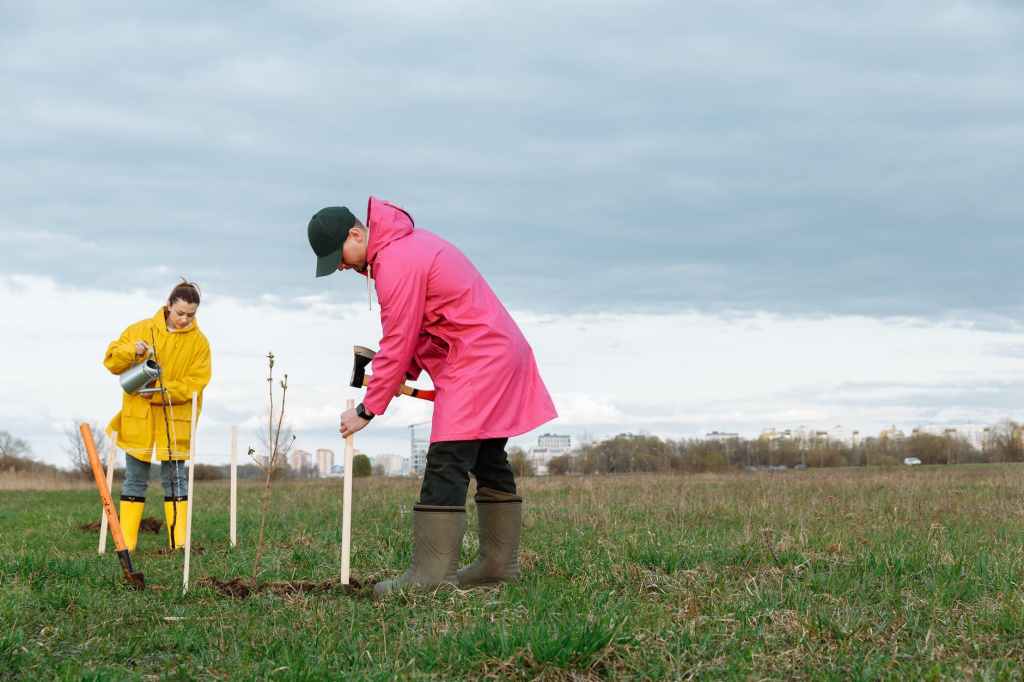
Tree planting has been presented to us as a sustainable manifesto; a no regrets campaign to get the UK closer to net zero carbon emissions whilst simultaneously portraying an arc of restitution for a depleted natural world. This movement, promoted by our major heritage and conservation organisations, contains both an implicit and explicit promise of conscientious nature recovery, where trees and the landscapes in which they grow will no longer be exploited by society but will be nurtured instead. The burgeoning forests of young trees arising out of this investment will, it is believed, nurture and protect us in the long-run through the ecosystem services they deliver: the carbon stock they store, the habitats for wildlife they provide and the flood-peaks they curb to name but a few.
So, it is no wonder that the public mandate for tree planting has been very strong. The public, the UK Government, NGOs and the private sector have all converged on the idea that millions of trees will need to be planted, primarily in the greenbelt and countryside, for rapid woodland creation up and down the UK. Leading the charge on this are the pragmatic town and country planners who say that tree planting must live amongst a balance of conflicting priorities. One of the policy mantras ringing out has been to plant the right tree in the right place for the right reason; that is, trees shouldn’t indiscriminately smother heaths, grasslands, fens, moors, mires and bogs in case they irrevocably puncture some kind of natural equilibrium or prevent some other productive use of this land.
The right tree in the right place for the right reason sounds sensible, and you’d be forgiven for holding good-faith in the guiding principles of this mission statement. But what are the right trees? what are the right places? and, what are these right reasons? I’ve done some digging into the plans, and I’m afraid they seem to belie the green mission being trumpeted.
Firstly it is worth looking at what the right tree is, or in other words, what type of woodland planting our policymakers will fund. Remarkably, the UK Government’s definition of woodland not only includes native deciduous broadleaf trees, but it also includes monocultures and polycultures of non-native conifer plantations. Perhaps these technically still are “woodlands”, but should they be wrapped up in a tree planting plan who’s primary goal is a green one? If a policymaker were to propose a policy to increase the area of grassland ecosystems, and then allow applications for not only semi-natural grass downland and wildflower meadows but also chemically fertilised arable wheat fields with some optional sustainability guidelines, you might question whether this was genuine scheme for nature recovery or simply agricultural subsidy in a new dress.
This definitional ruse is alarming, but surely the plan prioritises native woodland over non-native plantations?
Well no, it doesn’t. At present time of writing, half of all UK public tree planting is for non-native conifer monocultures of pines, spruces and larches. The sole purpose of these schemes is industrial scale timber production and harvesting. The Forestry Commission, the department concerned with managing and regulating timber plantations in the UK, believe that plantations create a balance of environmental, social and economic outcomes. Unsurprisingly, this belief is a falsehood. A large meta-analysis of 264 studies published in the prestigious and industry-independent academic journal Science has shown that new monoculture plantations are heavily weighted towards economic outcomes, that is, wood production. The authors demonstrated that native broadleaved woodlands composed of multiple tree species consistently deliver far greater environmental outcomes than non-native plantations and implored planners to focus on this type of restoration if they were prioritising delivery of ecosystem services like carbon storage, water provisioning and soil erosion control. so, it is clear that if planners really had a green agenda, they would prioritise the expansion of native woodland.
In the UK all woodland is managed to some degree, and what matters for the environmental sustainability of woodland after they’ve established is the regime under which they are managed. Currently, only 44% of coniferous and broadleaved woodlands are assured under a sustainable management standard. Remarkably (there are a lot of remarkably’s), the England Tree Action Plan does not make any mention of plans to increase this proportion; The Forestry Commission admit their sustainability standards are in decline; and moreover they project the majority of new planting to be delivered by the private sector, who will enjoy far less regulatory oversight and enforcement than government owned stock.
Maybe the management of new woodlands won’t be the best for nature, but surely huge gains for nature will amass simply by expanding the extent of woodland in favour of other worse land-use options. Again, I’m afraid to be the harbinger of bad news. The England Tree Action Plan and the UK Net Zero Strategy communicate the “ambitious plan” to expand woodland by a paltry 4% through to 2050; from 10% to 12% of land-area in England and 13% to 17% in the UK as a whole. Achieving this would still leave the UK teetering above the relegation zone in the “European League” for woodland area and still leave the UK as one of the most nature depleted countries in the world.
Under the trajectory laid out in these plans take a moment to imagine the mid-century, dream-world future conjured up by our most powerful institution: the same ecologically-barren landscape as we have now with a peppering of new intensively managed conifer plantations. Plantations that will continue to impose near irreparable damage on the countryside. Plantations that won’t tackle or help society adapt to the major environmental crises in front of it. Plantations that ultimately you and I will become inured to. Maybe you do not care about this, but this is it; this is the plan for a country that has contributed the most to ecological destruction and a country whose economic, social, and political health are founded exclusively on steady-state ecosystem services. Tree planting in the UK in its current form is not an agenda for serious nature recovery, nor is it intended to even put us on par with other Western nations. It is almost exclusively a plan for emboldening forest-product nationalism.
We must demand that woodland planting is redefined in policy. New conifer plantation targets and statistics should be ejected from key green and environmental documents such as the Tree Action Plan and the 25 Year Environment Plan. Ambitious targets and finance should then be honed in on the expansion of native multi-species broadleaved woodlands as well as rapidly expanding the total stock of woodland covered by sustainability standards (e.g. the UK Forestry Standard). The resulting statistics would then convey a more accurate picture of how the UK is performing on green issues. Until this is done, those without the time or means to investigate this issue will be pledging their support for targets, plans and statistics that are guilty of greenwash.
 dieback.